
If your basement only seems to get wet in March, April or May, you are not imagining it. Spring is the toughest season on Calgary foundations. Here is why it happens, what to check first, and how a lasting fix usually works.
Why spring is different in Calgary
Most basement leaks come down to one thing: more water sitting against the foundation than the walls and floor can keep out. In spring, Calgary stacks several causes on top of each other.
1. Melting snow on frozen ground
When snow melts, the top layer of soil is often still frozen. Water can't soak in, so it runs along the surface until it finds a low spot. Too often that low spot is the soil right next to your house, where backfill has settled over the years. The water collects there and works its way down the outside of the wall.
2. Chinooks and freeze-thaw
Chinook winds can melt a lot of snow in a day or two, then a cold snap freezes everything again. That cycle can repeat many times in a season. Each melt sends a pulse of water toward the foundation, and each freeze can block the paths that would normally carry it away, such as downspout extensions, swales and window well drains.
3. Clay soil
Much of Calgary sits on clay-rich soil. Clay drains slowly and holds water for a long time, so the ground around a basement can stay saturated for days after a melt or heavy rain. Clay also swells when wet and shrinks when dry, which can open small cracks and gaps over the years.
4. Spring rain on top of melt
May and June bring Calgary's heaviest rains, and sometimes hail. When those storms land on ground that is already soaked from snowmelt, there is nowhere for the water to go.
5. Water pressure against the walls
When the soil around a foundation is saturated, the water in it presses on the walls and under the floor. This is called hydrostatic pressure. Concrete is strong, but under that pressure water will find any weak spot.
Where the water usually gets in
- The floor-wall joint. The basement floor and walls are poured separately, so there is a seam where they meet. It is one of the most common places for water to show up.
- Wall cracks. Most foundations have some shrinkage cracks. Many stay dry for years, then seep when the soil outside is saturated.
- Tie rods and pipe openings. Small holes left from the forms, and gaps around water lines or other pipes, can let water through.
- Window wells. A well that fills with melt or rain can leak around the window frame.
- Floor cracks and drains. Water under the slab can push up through cracks or a floor drain.
Quick things to check this spring
Some spring leaks have simple outside causes. Before you assume the worst, walk around the house:
- Downspouts. Are extensions attached and carrying water at least a couple of metres from the house? Are they frozen or blocked?
- Grading. Does the soil slope away from the foundation, or has it settled so it slopes toward it?
- Snow piles. Shovel snow away from the walls, and don't pile it against the house or over window wells.
- Window wells. Clear out ice, leaves and debris, and check that the drain at the bottom isn't plugged. A cover can keep snow and rain out.
- Sump pump. If you have one, pour a bucket of water into the pit and make sure it switches on, pumps out and shuts off. Check that the discharge line outside isn't frozen.
If the leak continues after these are sorted, the problem is likely in the foundation itself.
How a lasting fix usually works
The right fix depends on where the water comes in and how much there is. A good inspection should find the source before anyone recommends a system. Common options include:
Crack injection
For a single leaking wall crack, the crack can be injected from the inside with a flexible material that fills it from front to back. This is clean, interior-only work.
Interior drainage to a sump
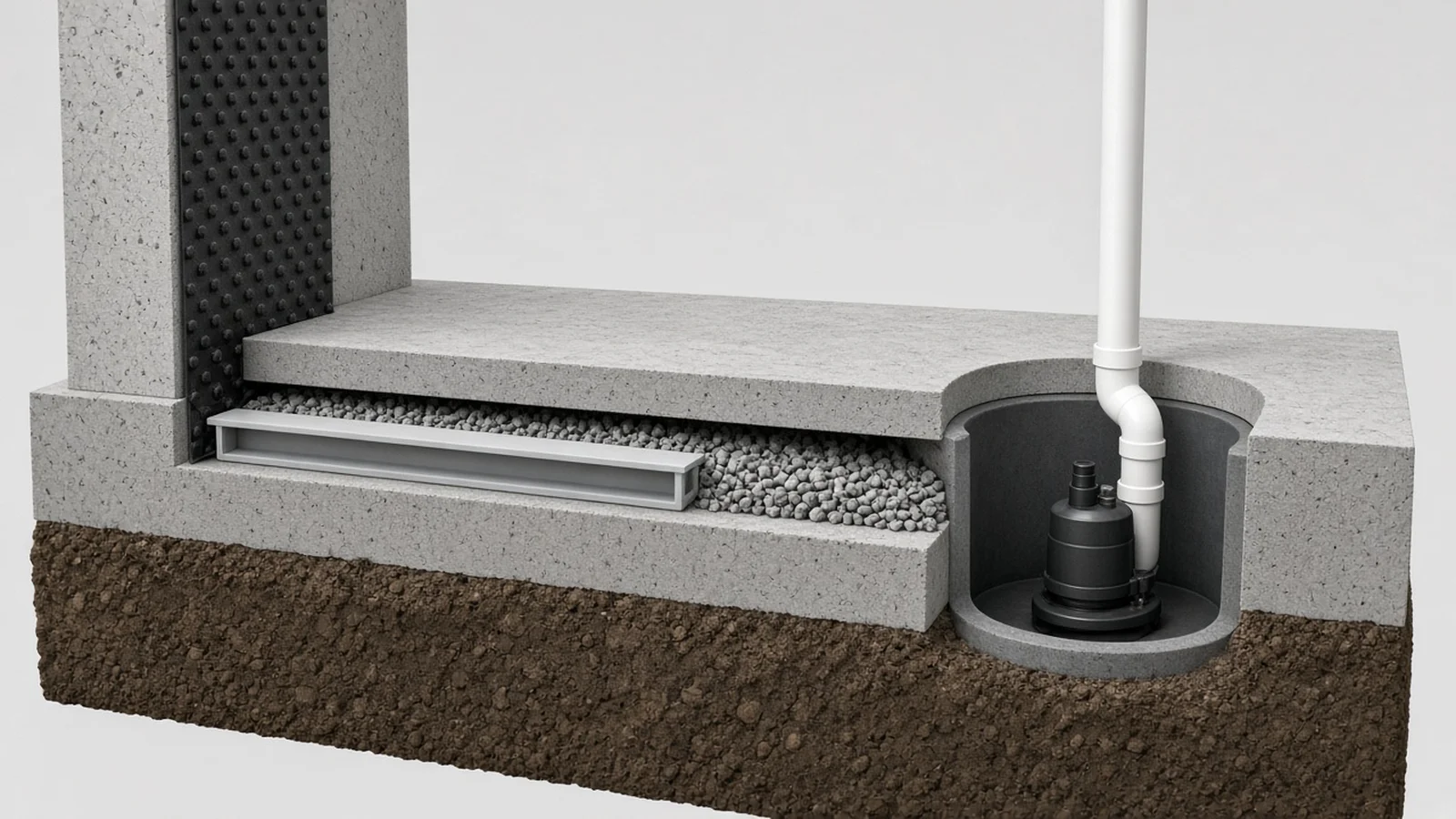
When water comes in along the floor-wall joint or through several spots, the usual long-term fix is an interior drainage system. A strip of the floor is removed along the wall, and a rectangular drainage channel is set on top of the footing, in clean gravel under the slab. The channel collects water that comes through the walls or the joint and carries it to a sump pump, which pumps it outside. The floor is then patched with new concrete, so the system sits out of sight. In spots that need extra capacity, perforated pipe may be added.
This approach doesn't try to stop every drop at the wall. Instead it gives water a controlled path away, which also relieves the pressure under the floor.
Wall membranes
A dimpled membrane on the inside of the wall guides seepage and condensation down into the drainage channel instead of onto the floor or behind finished walls.
Outside fixes
Regrading, longer downspout extensions and window well covers reduce how much water reaches the foundation in the first place. They are often worth doing alongside an interior system.
Common questions
My basement only leaks every few years. Is it still worth fixing?
A leak that only shows up in a big melt or a heavy storm tells you where the weak spots are. The next big event will find them again. Many homeowners act when they plan to finish or renovate the basement, so new walls and flooring aren't put at risk.
Is it a leak or condensation?
Not every damp basement is a leak. In summer, humid air can condense on cool walls, floors and pipes. One simple test is to tape a square of plastic to the wall for a day or two. Moisture under the plastic points to water coming through the wall. Moisture on top points to condensation, which is a humidity problem.
Can I fix it from the outside instead?
Sometimes. Outside fixes like grading and downspout extensions are worth doing whenever they're needed. Digging out the full foundation is a much bigger job, and decks, driveways and landscaping often get in the way. For most Calgary homes, an interior system is the more practical way to manage water that still gets through.
Don't wait for it to dry out
It is tempting to mop up and forget about it once the weather turns. But water that gets in each spring keeps coming back, and over time it can lead to mould, damaged flooring and drywall, musty smells and higher humidity all year. If you plan to finish your basement, fix the water first.
The short version
- Calgary springs combine snowmelt on frozen ground, chinook freeze-thaw cycles, slow-draining clay and heavy rain.
- Water usually gets in at the floor-wall joint, cracks, tie rods, pipe openings and window wells.
- Check downspouts, grading, snow piles, window wells and your sump pump first.
- Persistent leaks are usually fixed with crack injection or an interior drainage channel to a sump, sometimes with outside improvements too.