
Yes. Radon is a real concern in Calgary and across southern Alberta. The good news is that it is easy to test for, and high levels can be brought down with a proven, fairly simple system. Here is what Calgary homeowners should know.
What radon is
Radon is a radioactive gas that forms naturally when uranium in soil and rock breaks down. You can't see it, smell it or taste it. Outdoors it thins out quickly and is harmless at those levels. The problem starts when it seeps into a house through the ground and builds up indoors.
Health Canada says long-term exposure to high radon is the leading cause of lung cancer in people who have never smoked, and the second leading cause overall after smoking. The risk comes from breathing elevated levels for years, not from a short visit to a basement, which is why testing your own home matters.
Why Calgary homes are affected
Radon levels depend on the local geology, and the soils under much of the Prairies, including the Calgary region, can release it. Health Canada's national surveys have found homes above the guideline in every province and territory, and Alberta has a meaningful share of them. Two houses side by side can test very differently, so a neighbour's result tells you little about yours.
Several things about how we build and live here can make it worse:
- Long heating seasons. Warm air rising inside the house creates a slight suction at the basement level that pulls soil gas in through the floor. Calgary furnaces run for much of the year.
- Tight, energy-efficient homes. Newer homes leak less air, so gas that gets in has fewer ways out.
- Openings to the soil. Sump pits, floor drains, cracks in the slab, the joint where the floor meets the wall, and gaps around pipes are all entry points.
- Finished basements. More families now sleep, work and play in the basement, the level where radon is usually highest.
The Health Canada guideline: 200 Bq/m³
Radon is measured in becquerels per cubic metre (Bq/m³). Health Canada's guideline is 200 Bq/m³ in the normal living areas of a home. Health Canada also gives timelines for fixing high levels:
- 200 to 600 Bq/m³: reduce the level within two years.
- Above 600 Bq/m³: reduce the level within one year.
Lower is always better. The guideline is an action level, not a line where the risk suddenly appears, so many homeowners choose to act on results that sit close to it.
How to test your home
Testing is the only way to know. Health Canada recommends a long-term test of at least three months, ideally during the fall and winter, when windows are closed and the house is under the most suction. Radon levels move up and down from day to day, so a short test of a few days can give a misleading answer.
- Place the detector in the lowest level where someone spends at least four hours a day, such as a finished basement bedroom or family room.
- Keep it away from drafts, exterior walls, sump pits and heat sources, and roughly at breathing height.
- Leave it alone for the whole test period, then send it to the lab as the kit directs.
You can buy a long-term detector yourself, or have a professional run the test. Either way, the result gives you a number to compare to the guideline.
What mitigation looks like
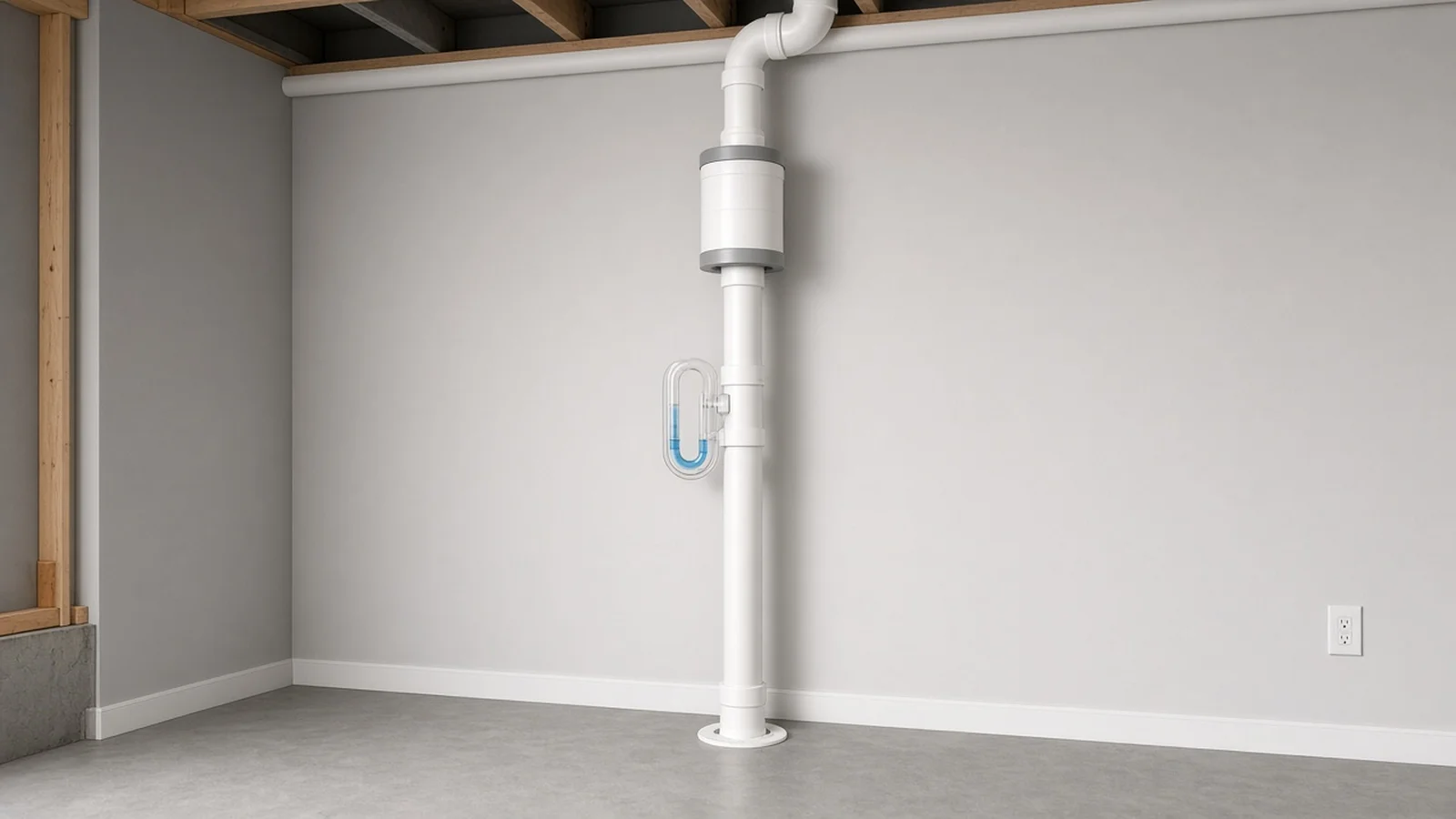
The most common and effective fix in Canadian homes is called sub-slab depressurization. In plain terms:
- A small hole is made through the basement floor, and some gravel or soil is removed under it to create a suction point.
- A sealed pipe runs from that point up and out of the house.
- A quiet inline fan in the pipe runs all the time, drawing soil gas from under the slab and venting it outside, away from windows and doors.
- Open entry points, such as the sump lid, slab cracks and gaps around pipes, are sealed so the system can work better.
- A small gauge on the pipe shows the system is running.
In most homes this is a one-day install. Afterward, Health Canada recommends testing again to confirm the level has dropped, and re-testing from time to time or after major renovations.
Health Canada recommends hiring a professional certified under the Canadian National Radon Proficiency Program (C-NRPP) for mitigation work.
Does sealing cracks alone fix radon?
Usually not. Sealing cracks and capping the sump help, and they are part of a good system, but on their own they rarely bring a high reading under the guideline. Concrete has tiny pores and new hairline cracks form over time. The active fan system is what reliably lowers levels.
Radon and the rest of your basement
Radon work fits naturally with other basement projects. A sealed sump lid helps with radon and humidity. If you are planning to finish your basement, test first, so a suction point can be planned before walls and flooring go in. If you have a crawl space, a sealed liner can also be part of reducing soil gas.
Common questions
My house is new. Do I still need to test?
Yes. Age doesn't predict radon. Newer homes are often tighter, which can keep more of it inside. Some newer homes have a capped pipe roughed in under the slab, which makes adding a fan later simpler, but only a test tells you whether you need one.
Does opening windows help?
Fresh air can lower levels for a while, but it isn't practical through a Calgary winter and the levels come back once the windows close. It isn't a substitute for a proper system.
What if I'm selling or buying a home?
A short test is sometimes used during a sale because of timing, but it can't replace a long-term result. If you're buying, plan to run a long-term test after you move in. If you're selling and already have a long-term result, it is useful information for buyers.
Will a mitigation system be loud?
The fan is a small, continuous-duty unit. It is usually placed where the sound isn't noticeable in living spaces, and the pipe is routed as neatly as the home allows.
The short version
- Radon is common enough in Calgary that every home should be tested.
- Use a long-term test of at least three months, ideally in fall or winter.
- If your result is above 200 Bq/m³, plan to reduce it within Health Canada's timelines.
- A sealed pipe and fan system under the slab is the proven fix, and is usually installed in a day.
Source: Health Canada, Radon and its guide for homeowners.